Learning how to organize spices is one of the most satisfying kitchen projects you can do in an afternoon. A messy spice collection slows down every meal: you dig for the cumin, find three half-empty jars of oregano, and give up on the recipe that needed sumac because you can’t remember if you have any.
A good system fixes all of that. This guide walks through the whole process, from clearing out old jars to choosing where spices live, picking a sorting method that suits the way you cook, and labeling everything so it stays organized.
The short answer
- Empty everything onto the counter and get rid of old, duplicate and unused jars.
- Choose one home for spices: a drawer, a cabinet, a rack or a mix.
- Pick a sorting system you’ll actually keep up, like by use or alphabetical.
- Decant into matching jars if you can, and add one style of label to every jar.
- Review twice a year and replace spices that have lost their smell.
Step 1: Take everything out
The first rule of spice organization is that you can’t organize what you can’t see. Take every jar, bag, packet and tin out of the cupboards, drawers and pantry, and put them all on the counter or the kitchen table.
You’ll probably find more than you expected. Spice collections grow one jar at a time, and duplicates hide at the back of shelves for years. Group identical spices together as you go, so you can see how many jars of paprika you really own.
Step 2: Clear out what you don’t need
Now be honest. Make three piles:
- Keep: spices you use and that still smell strong.
- Combine: duplicates you can pour into one jar, if they’re of similar age.
- Let go: spices that have lost their color or smell, flavors you never use, and anything with signs of moisture or clumping.
Dried spices don’t usually go bad in a way that makes you ill, but they lose flavor over time. According to McCormick, ground spices generally keep their best flavor for a couple of years, while whole spices last longer. The spice shelf life chart lists 40 common spices and how long each one stays at its best.
A quick test: crush a pinch between your fingers and smell it. If you have to search for the aroma, it’s time to replace it.
Step 3: Decide where your spices will live
The best home for spices is cool, dry and dark, but also close to where you cook. Heat, light and steam all speed up flavor loss, which is why food safety experts at Texas A&M AgriLife Extension recommend keeping spices away from the stove and out of direct sun.
Here are the main options and what they suit:
| Storage | Best for | Watch out for |
|---|---|---|
| Drawer | Medium to large collections, easy scanning | Needs lid labels to read from above |
| Cabinet shelf | Small collections, tiered risers | Jars hide behind each other |
| Door rack | Small kitchens, freeing up shelves | Limited jar sizes |
| Wall rack | Everyday spices near the stove | Light and heat exposure |
| Turntable | Corner cabinets | Uses a lot of shelf space |
| Pull-out rack | Narrow gaps beside the stove | Usually needs installing |
Many kitchens use a mix: a drawer for the main collection, a small rack for the five spices you use daily, and a pantry shelf for bulk refills. For drawer layouts in detail, see the spice drawer organization guide. If space is tight, the small kitchen spice storage guide has ideas that don’t need extra cupboards.
Step 4: Choose how to organize spices
How you sort matters more than where you put things. The right system depends on how you cook and how big your collection is.
By how often you use them
Everyday spices like salt, pepper, garlic powder, paprika and cumin go in the easiest spot. Occasional spices go further back. This is the most practical system for most home cooks, because the jars you reach for every day are always at hand.
Alphabetical
Alphabetical order works brilliantly for large collections of 40 or more spices. Anyone in the house can find anything, and you can see at a glance whether you already own something before you buy it.
By cuisine or purpose
Group baking spices together (cinnamon, nutmeg, cloves, allspice), then Indian spices, Mexican spices, Italian herbs and so on. It’s handy if you cook a lot of one style of food, and it lets you lift out a whole group for a recipe.
By type
Some people separate dried herbs, ground spices, whole spices and blends. It looks neat but isn’t always practical, because recipes mix all four.
The guide to the best way to arrange spices compares these systems in more detail and helps you choose.
Step 5: Decant into matching spice jars
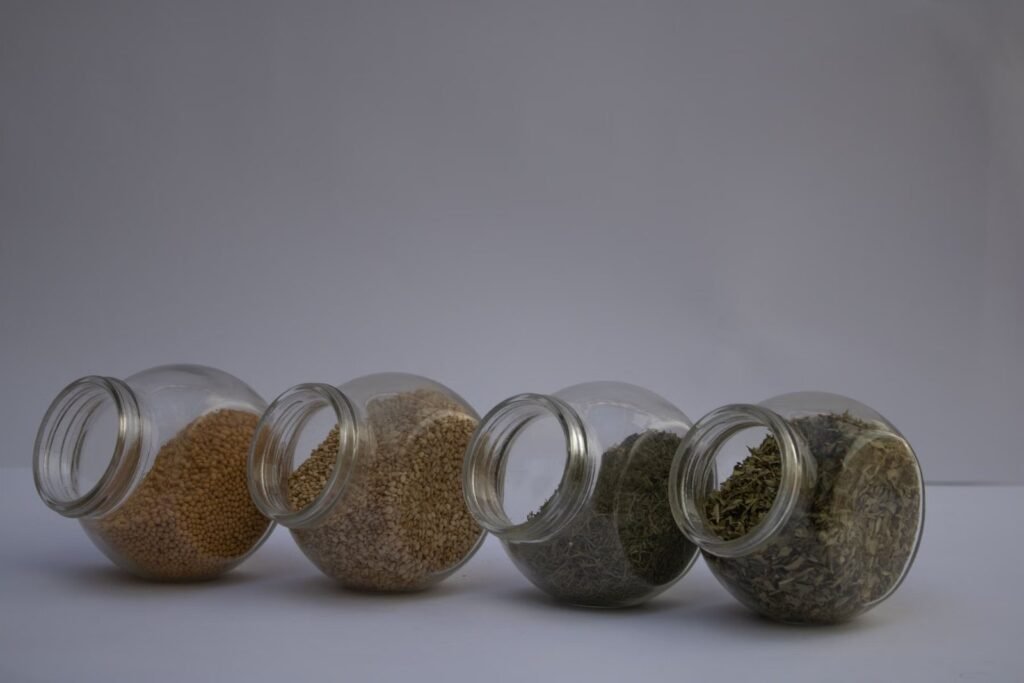
Matching spice jars aren’t essential, but they make a huge difference. They stack and line up evenly, they’re easier to label, and the whole collection looks calm instead of cluttered.
When choosing spice jars, think about:
- Size: 4 oz jars suit most spices; smaller 2 oz jars suit spices you use rarely.
- Material: glass is easy to clean and doesn’t hold smells; tins block light completely.
- Lids: shaker tops for everyday spices, plain lids for spices you measure with a spoon.
- Shape: square jars waste less space in drawers and on shelves.
The spice jars guide compares sizes and materials and explains how to store spices so they last.
Step 6: Label everything
Labels are what turn a set of jars into a system. Without them, you’re back to sniffing jars to tell chili powder from paprika.
Good labels share three things: one style across every jar, a clear readable font, and the same position on each jar. If your spices live in a drawer, add a small label to each lid too.
The free spice label maker lets you paste your whole list of spices, pick one of 24 styles and print a full matching set in minutes. You can add a “best before” date to each label so you know when to refresh, and the printable spice jar labels guide covers paper, sizes and printing tips.
Step 7: Put it all back
Now return everything to its new home in the order you chose. A few tips:
- Front row, daily spices. Whatever your system, the five spices you use most belong in the easiest spot.
- Use risers on shelves so back rows aren’t hidden.
- Leave a little space for new spices, so the system doesn’t collapse the first time you buy something.
- Refresh the rack itself if it looks tired. The spice rack makeover guide shows a budget before and after.
- Keep refills separate. Store bulk bags in the pantry with matching labels, not crammed into the spice drawer.

Step 8: Organize the rest of the pantry
Once spices are done, it’s tempting to keep going. Flour, sugar, rice, oats and pasta all benefit from the same approach: clear containers, one label style and a fixed home. The pantry labels guide shows how to extend your spice labels to canisters so the whole kitchen matches.
If you’d like a particular look, from farmhouse to minimal, the kitchen label ideas guide walks through every style and how it suits different kitchens.
Step 9: Keep your spice organization going
The hardest part of spice organization is keeping it up. These habits help:
- Put jars back in their place right after cooking, not at the end of the day.
- Write new spices on a list and print their labels in batches.
- Refill from bulk bags when a jar gets low, rather than buying a new jar.
- Check smells twice a year, perhaps when the clocks change, and replace anything faded.
- Keep the system simple. If you find yourself not using it, simplify it rather than abandoning it.
Spice organization on a budget
You don’t need to spend much to organize spices well. Start with what you have: wash and reuse empty jam or baby food jars as spice jars, cut a shelf liner to stop jars sliding, and use a shoebox lid as a drawer tray. Labels make the biggest visual difference for the least money, because a row of mismatched spice jars with one matching label style instantly looks planned. Print them free, then upgrade jars and racks slowly as your budget allows.
Common spice organization mistakes
- Storing spices above the stove. It’s convenient but the heat and steam fade flavor quickly.
- Buying huge jars of spices you rarely use. Buy small, refill often.
- Organizing without decluttering first. You’ll just neatly store jars you don’t need.
- Mixing label styles. One style looks planned; several look accidental.
- Making the system too complicated. If it takes longer to put a jar away than to use it, you won’t keep it up.
Once you know how to organize spices, it takes only a few minutes a month to keep everything tidy, and every meal starts a little more calmly.
Frequently asked questions
What is the best way to organize spices?
The best system is the one you’ll keep up. Most people do well with everyday spices at the front, grouped by use, and a matching label on every jar. Alphabetical order suits large collections.
Where should spices be stored in the kitchen?
Somewhere cool, dry and dark, close to where you cook but not directly above the stove. A drawer or cabinet beside the stove is ideal.
How often should I clear out my spices?
Go through them once or twice a year. Smell each jar and replace any that have lost their aroma or color.
Should I decant spices into matching jars?
It isn’t essential, but matching jars with matching labels make spices much easier to find and give the kitchen a calmer look.
How many spices does a typical kitchen need?
There’s no right number. Many home cooks use around 15 to 25 regularly. Keep the ones you use and give away the rest.
Save it for later
Pick your favorite pin and save it to your Pinterest board.